By a Staff Photographer
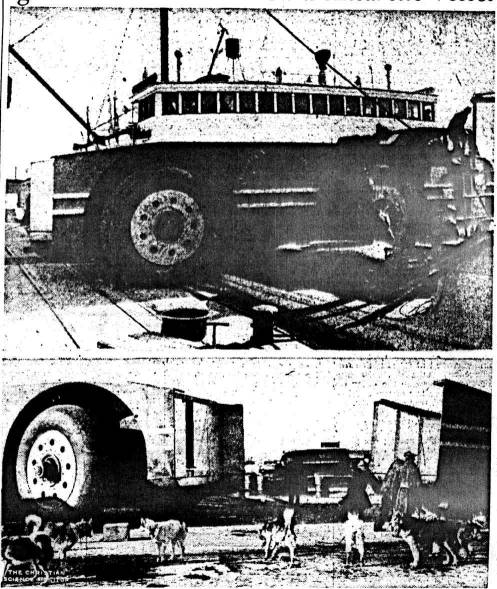
Upper: The 37-ton snow cruiser of the Byrd Antarctic Expedition, truncated by the removal of its 10-foot spare-tire rack, is shown being rolled onto the fore deck of the North Star, at the Army Pier in Boston, a few hours before the expedition vessel was scheduled to sail. Lower: The tire rack is being removed to make the big, mechanical dog sled fit on the vessel's deck.
The North Star, supply ship of Rear Admiral Richard E. Byrd's third antarctic expedition, will sail from Boston at 6 a. m. tomorrow, Lieutenant Commander Isak Lystad, skipper of the vessel, announced this afternoon.
Although noon today had been fixed by Admiral Byrd as the zero hour for sailing for Little America, there still remained four hours work of shifting and stowing last-minute cargo placed aboard the vessel, Commander Lystad said.
In addition, the work of checking the compasses of the ship must be done by daylight and requires three hours, so it would be impossible to leave today in time to have sufficient daylight for the checking work, it was explained. The ship, therefore, will pull into the channel at dawn tomorrow for the calibrating of her compasses and then head for the South polar region.
The last major item of supply, the 37-ton oil-burning, snow cruiser, which reached Boston yesterday after an 18-day cross- country odyssey, was stowed snugly aboard this morning.
Admiral Byrd, who arrived shortly after noon to supervise departure of the vessel, which he will join at Philadelphia or at Panama, emphasized the semipermanent nature of the work of the expedition.
Semicolonizing Enterprise
In many quarters, the expedition has been described as a semicolonizing enterprise, and the Admiral added strength to this view, although he did not use the word colonize.
"In a sense," he told reporters in the officers' mess room while anchor chains rattled overhead as the snow cruiser was being made fast to the deck, "in a sense, this is the beginning of a semipermanent thing.
"It all depends upon what Congress appropriates," he said. "The idea is to carry on for some years, not 15 or 20, but perhaps five or six years. The men will be relieved each year under this plan. Few will want to stay two winters. For most men, one is usually enough."
Admiral Byrd reiterated that the objects of the expedition are to "substantiate claims to areas discovered and claimed, and we hope to discover some unknown areas and claim them," and to obtain data and observations for "at least 15 different branches of science."
He scouted the idea that precious metals, except coal, would be found in the Antarctic in any quantity, and suggested the coal would not be easily accessible. The chief value of Antarctic development, he said, would be along aviation lines.
"Of great importance is a good plane route from the Americas to Australia," he declared. "By way of Little America, the longest-hop is 1,800 miles. This would cut out the risk of long water flights. Of course, this is not practical as aviation stands today, for bases have not yet been developed."
The Admiral was greeted by officers and members of the crew as he boarded the vessel.
"This feels like the South Pole," he exclaimed as he stepped aboard, referring to the 26-degree temperature and brisk wind which kept crew and spectators shivering throughout the morning.
A 50-piece band, known as the Commonwealth Band, under the supervision of William F. Sargent, was on the dock waiting to give the Antarctic ship a send-off. Relatives and friends of the officers and crew were aboard the vessel and on the dock.
Snow Cruiser Aboard
The snow cruiser was put aboard without a hitch. Despite its huge size, the 55-foot, mobile igloo, with its last 10 feet removed to abbreviate its length, was maneuvered from the Army Pier to the forward well deck of the North Star in less than 15 minutes.
Careful preparations preceded the actual loading. Not only had the 10-foot tire rack been cut from the rear with acetylene torches, but the deck of the ship had been heavily planked, and the Navy tug Nottoway had been placed with her nose against the port side of the North Star to keep her against the pier during the loading. Even the hour had been carefully selected, so the high tide would raise the deck of the vessel even with the pier.
At 10:10 a. m., Dr. Poulter climbed into the cab of the Antarctic bus (Sailors using nautical terms, call it the "bridge" of the "cruiser.") Seated at the control board, Dr. Poulter straightened the 10-foot, rear wheels, moved the snowmobile slowly forward.
At the edge of the dock, Dr. Poulter stopped, climbed down from the "bridge" for a last check of the 11/2-ton rubber-tired wheels. He returned to the driver's seat.
"Come ahead," beckoned Lieutenant Commander Isak Lystad, skipper of the North Star, from the well-planked deck.
Sailors watching the hub-caps of the snowmobile to see that they missed the superstructure of the vessel as it rolled aboard, called "All clear."
The big moment was heralded by the Antarctic mastodon with two thin, little toots from a small horn such as one would expect on an ancient flivver. The steel igloo crept forward, the front wheels rolled onto the North Star, the deck listing six inches under the weight, while the Navy tug pressed firmly against the other side of the vessel.
Spectators Cheer
The rear wheels rolled aboard, and the vessel straightened to an even keel. The cruiser moved into position lying across the deck, directly under the vessel's bridge. It was safe aboard.
A cheer went up from the crowd of about 200 who stood about, trying vainly to keep warm on Boston's coldest day of the season.
While the cruiser appeared to fit snugly behind the fo'castle head, it was found, about an hour later, to be projecting slightely over the starboard side, which was next to the pier.
With the ebbing of the tide expected at 1 p. m., it was realized the cruiser might catch on the pier as the vessel fell with the tide. So the North Star cast off and anchored about 100 yards out in the harbor. She tied up at the pier again later.
Relatives and friends of the 60 officers and men who were sailing on the North Star bade farewells during the morning. The cold weather, intensified by a strong wind that blew in from the harbor, gave an appropriate setting for the polar expedition's departure.
The mother of one of the men was heard to warn her son, solemnly, "Be sure to keep your warm clothes on!"
Indeed, many of them had already put on their parkas and heavy mittens as a protection against Boston weather. Some wondered if it seemed so cold up here, what it would be like in Little America.

