|
Tennessee Technological University, Cookeville, TN, USA
J. STEPHEN DIBBERN Received February 1985 |
| ABSTRACT. In 1939 Dr Thomas C. Poulter, Director of the Armour Institute, Chicago and a veteran of Byrd's second Antarctic expedition, designed and constructed a 30 tonne wheeled vehicle known as the Snow Cruiser for use with the US Antarctic Service Expedition. Designed for self-contained long-distance travel, the vehicle had many new features including twin diesel engines, independent electric drive and steering on each of its four wheels, and a light aircraft carried on the roof. It was built in Chicago and tested briefly on sand dunes nearby, before being driven to Boston amid much public interest for shipment to Antarctica. At the Bay of Whales the vehicle quickly became bogged down in snow, and never moved farther south than the expedition's winter quarters. Modern evaluation of wheel-snow interaction suggests that the Snow Cruiser unladen was three to five times too heavy for its tyres to support it on snow surfaces. It was nevertheless a bold attempt to push forward the frontiers of mobility in exploration, which failed in a spectacular fashion. The vehicle was left behind when the expedition returned home, and has subsequently been lost. |
|
|||||||||||||||||||||||||
In 1939, when Rear-Admiral Richard E. Byrd began to plan his third private Antarctic expedition, World War II was imminent. In 1938-39 a German expedition was investigating the Antarctic coast within the African quadrant. Though it was ostensibly conducting scientific studies, its location seemed to have been chosen more for proximity to Cape Horn commercial shipping lanes than for scientific reasons, and US observers believed a southern base was being sought. Independently of Byrd two other Americans, Richard Black and Finn Ronne, were also preparing Antarctic expeditions. In seeking the help, or at least the approval of the government, Black and Ronne aroused the interest of the Interior and State departments. President Roosevelt became involved and brought Byrd into consultation, eventually appointing him leader of a government-financed expedition based on Black's and Ronne's plans. In July 1939 an executive committee was formed to oversee the United States Antarctic Service (USAS), the first official US government activity in the Antarctic for nearly 100 years.
The 1939 USAS Expedition differed from previous ones in several ways. It was much better equipped with mechanical and electronic aids, and also much larger - so much so that even an individual and charismatic leader like Byrd could not handle all the myriad details of its inception. The bulk of the effort fell on the shoulders of some of Byrd's aides from previous expeditions. Paul Siple, Richard Black, F. Alton Wade and Thomas Poulter became key men in preparing the expedition for the field. Operational planning was based on Byrd's earlier expeditions, involving two base camps, dog-sledging parties, aerial support and reconnaissance, voice radio, and crawler tractors to help move supplies. Paul Siple was selected to command the West Base at Little America, Richard Black to command the East Base on Antarctic Peninsula.
Early in the planning Thomas C. Poulter, a veteran of Byrd's second Antarctic expedition, introduced a new concept of Antarctic travel based on a mobile, self-sufficient exploration unit for long-distance work in the interior of Antarctica. A physicist by training, Dr Poulter had won his leader's confidence when left in charge of Little America II during Byrd's lone stay at the Advance Weather Base. Currently Director of the Armour Institute in Chicago, Poulter's interests ranged from astronomy to chemistry and biology. He was also practically minded, inventive, and an engineer at heart with a gift for improvization. Expedition accounts often mentioned that Poulter had devised a gadget to fulfil a need. In winter 1934 he had helped to rescue Byrd, travelling 160 km [100 miles] on a Citroen tractor through blizzard conditions with temperatures down to -57°C. The journey would not have succeeded without travelling aids which Poulter improvized - a searchlight rigged from scrap metal and the camp movie projector, and trail lights that marked the way back through the winter darkness.
Poulter was convinced that the future of polar travel lay in overland vehicles. Though aircraft were useful in covering large distances rapidly, their use was restricted, especially by weather. Earlier in the century Shackleton, Charcot, Scott and Mawson had all tried motor vehicles to replace dogs and men as a power source for sledging, but their vehicles were hopelessly inadequate. On his first Antarctic expedition of 1929 Byrd had included two small Ford vehicles with tracks replacing the rear wheels. The Ford engine was a little more reliable than earlier ones but underpowered. After his second expedition, involving stronger and more reliable vehicles, he had written that mechanical transport would provide the next great step, in south polar transport, while adding cautiously '...but there is no getting away from dogs... the one absolutely reliable means of polar advance' (Byrd 1935).
In arguing for a 'snow-cruiser' Poulter pointed out that ships could touch only the edges of the continent, while aircraft required elaborate bases and reliably good weather. For long-distance work traditional dog teams were too slow: a journey of 3,000-5,000 km [2,000-3,000 miles] by dog team would require at least two seasons, and dogs continued to consume supplies during periods of inactivity. Tracked motor vehicles, even those used on Byrd's second expedition (1933-35), had in general proved too unreliable and slow to venture far from base.
Poulter drew up 10 requirements for an ideal unit. It would have a range of 6,500-9,500 krn [4,000-6,000 miles] be able to negotiate open crevasses up to 4.6 m [15 feet] wide, and capable of approaching within 160-320 km [100-200 miles] of any point on the Antarctic continent or barrier ice, with auxiliary means of covering that distance. It should carry facilities for aerial observation arid photography, cruise at not less than 8 km per hour [5 mph] (preferably twice as much), allow for stopping anywhere for as long as necessary, expending only food and heating fuel, and carry a crew of three to six men (ideally four). The unit should not need an extensive base camp, and should carry equipment for determining to within 1 km [half a mile] the position of any mountain peak or prominence visible. In case of a blizzard it should be necessary only to head the unit into wind and sit it out. It should be possible to travel year-round (except during blizzards) and 24 hours a day, allowing time and facilities for regular meals and sleep. The unit should carry provisions for at least one year, and in emergency allow the crew to reach some point on the coast where seal meat was available and a ship could pick them up. Finally it should carry radio equipment for communication with the United States, and facilities and personnel for a very comprehensive scientific programme (Mechanical Engineer 1939).
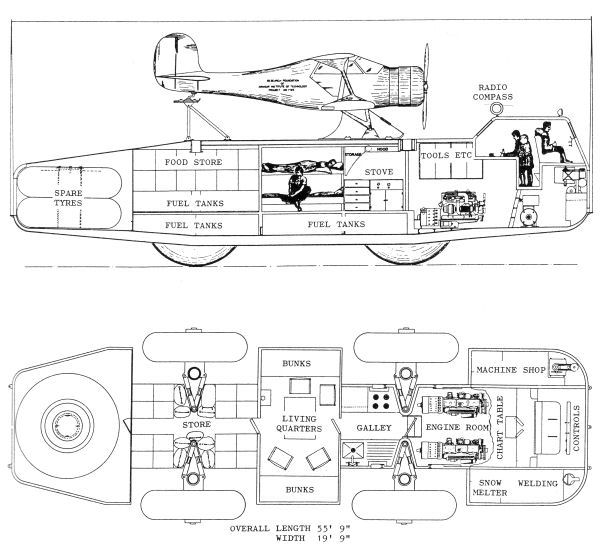
Poulter had in mind a large, self-sufficient vehicle with a small scouting aeroplane carried on the roof (Figure 1). His institute, a prestigious and wealthy endowment of the Armour meat-packing fortune, provided him with a base of operations, a source of funds and a pool of design talent. He promised to handle all financial, design and construction arrangements, and was able, in the space of a few months, to accomplish exactly what he had promised.
Genesis
Formed in 1936, the Armour Foundation was dedicated to the support of research and development. As its first director Poulter undoubtedly enjoyed considerable latitude in deciding which projects to support, and the design of an oversnow vehicle was among the first to be considered by his team of bright, innovative designers and engineers. When in 1939 Byrd was appointed to lead the USAS expedition to Antarctica, Poulter was quick off the mark. he was immediately able to dedicate part of the finances and staff resources of his institute to developing a snow cruiser, at no cost to the US government. All he sought in return was a crew, and logistic support to get the machine into the field.
Poulter had almost certainly begun to plan his vehicle as early as 1936, and the idea may have germinated while he was still in the Antarctic (Poulter 1977). One of his companions on the Byrd rescue journey, E. J. ('Pete') Demas, in an interview recorded in 1979 (and now held in the Polar Archives of the US National Archives) claimed that he and Poulter had discussed designs for a mobile laboratory while Byrd was convalescing, and reached contradictory conclusions. Poulter had favoured a wheeled vehicle with large pneumatic tyres; Demas had opted for a tracked vehicle because he believed this alone could provide the traction and flotation needed to cope with soft snow. He recalled experiences, shared with Poulter, of frequent mechanical failures of the vehicles on the second Byrd expedition his view Poulter had either forgotten them, or simply chosen to be optimistic.
In designing the vehicle Poulter certainly drew on Antarctic observations. In 1934-35 he had measured gradients of representative slopes, widths of crevasses and (a key element in his calculations) some properties of the snow of the Ross Ice Shelf, including bearing capacities and coefficients of friction between snow and such materials as steel, wood and rubber. These measurements ultimately proved his undoing, for at the time neither he nor anyone else knew how to interpret them - not until the middle 1950s did studies of oversnow vehicles begin to reveal their requirements. Poulter's measurements convinced him that Antarctic snow could support a load intensity of 210 kPa (30 pounds per in²). Giving himself a safety factor of two, he was sure that a vehicle designed for 105 kPa would easily travel over the snow. Demas (1936) thought differently: he believed that tractors to be used in the Antarctic should he built of light material and have a maximum bearing load of 1 psi [6.895 kPa].
Poulter does not seem to have recorded the values he obtained for the coefficient of friction of rubber on snow. There is no evidence that he recognized the marked effect of temperature on this value. However, he does state in his account of the Snow Cruiser's trial, that sand was representative of the Antarctic snow, which suggests that his measurements of now were made at very low temperatures.
|
The length and wheel base of the vehicle were determined by the width of the crevasses it would have to cross. Poulter decided from his measurements of crevasses that if his Snow Cruiser could cross one 4.5 m wide it could reach the Antarctic Plateau, where there are relatively few, He also decided that if the vehicle were long enough and had an adequate wheelbase it could withdraw from crevasse bridges without plunging down the crevasse.
This then was the grand design that Poulter conceived to cope with Antarctic travel. He planned methodically, tested all the hazards and quantified them, and then devised ways to surmount them. The final cost to the Armour Foundation and various contributors was an estimated $150,000 (Fitzpatrick 1940; Poulter in letter to Dibbern 1977).
The Snow Cruiser
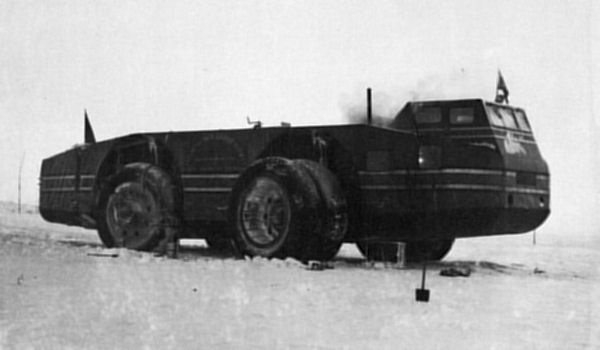
The vehicle that emerged from Poulter's drawing board was built in the nearby Chicago shops of the Pullman Company, the well-known builder of railway sleeper cars. Indeed in its design and execution the Snow Cruiser bore many resemblances to a private railway car (Figures 1 and 2). It was 16.75 m long, supported by four wheels with pneumatic tyres on a wheel base 4.5 in long and on 4.5 m centres. With body shell in place it stood 4.5 m high and 6.10 m wide. Interior layout provided sleeping quarters for four, a welding and machine shop, a darkroom and a combined galley and instrument room. The chart and radio room was large enough to accommodate the entire crew simultaneously. Space remained for a year's supply of food, two spare tyres, and an engine room containing two 112 kW diesel engines, two 75 kW electric traction generators, and two hydraulic pumps rated up to 34.5 mPa pressure. The fuel tanks held 9,500 litres of diesel fuel, 3,800 litres of aviation fuel and 2,800 litres of white gasoline (Davis 1939; Mechanical Engineer 1939; Fitzpatrick 1940).
|
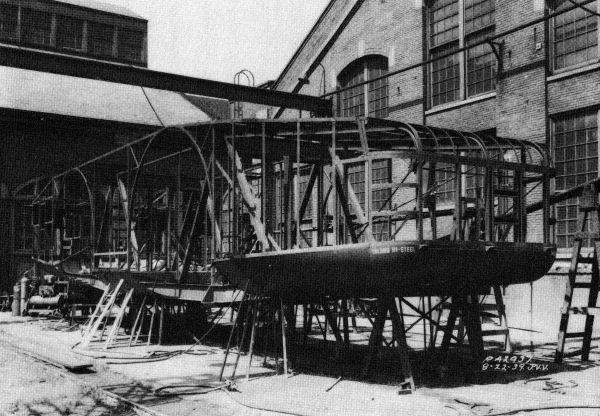
The skeleton (Figure 1) was welded I-section beams of low-carbon steel ('Hi-steel'), selected for resistance to impact loading at low temperatures. The skin was of welded or rivetted 28 gauge steel (selected, according to the builders, to save weight). The vice-president of the welding company claimed that welding rather than rivetting saved 2,200 kg, and each kg saved represented 1.5 km cruising range (Davis 1939); only Poulter could have supplied those figures. The overall weight is unknown. None appears in the specifications, though estimates in the literature range from 24.5 to 50 tonnes, and we believe it to have been about 30 tonnes. Probably the vehicle was never weighed.
Mechanically this was a complex though versatile machine. Each wheel was driven by its own hub motor, with electricity generated by the twin diesel engines. Front and rear wheels were pivoted and controlled independently from cockpit levers; the vehicle could turn in its own length or steer crabwise 25 degrees to either side. The wheels could be raised hydraulically so the cruiser rested on its belly, or lowered to give a metre of clearance above the surface. To bear the great weight four large tyres up to 9 m in diameter were discussed, but making them specially in the short time available would have presented a formidable challenge. Instead Poulter accepted from Gulf Research a set of moulds for large tyres 3 m in diameter and 0.9 m wide, developed by Goodyear for a lightweight swamp vehicle used in oil prospecting. Strengthened with extra plies, tyres for the Snow Cruiser were formed from the best low temperature rubber compound available. The tyres were to be inflated to between 100 and 175 kPa, depending on load and condition. Poulter estimated a bearing area for each of 0.75 ml, though this would vary with load and snow penetration, and could only be approximate. Two spares were carried in a rear compartment of the vehicle.
In the driver's cockpit two hand levers controlled the generators, giving backward or forward motion, and two pedals for the right foot controlled engine speed; switches in the engine room determined the number of engines engaged. A second hand lever on the right controlled the front wheels, one on the left the rear wheels; each could be made to control one or both wheels of its pair, and in driving the Cruiser both were constantly in use. Pedals by the driver's left foot controlled two brakes, one for each pair of wheels. On the dash board were gauges for water temperature, oil pressure and hydraulic pressure and a tachometer for each engine. Centrally placed was a steering control indicator, consisting of four knobs directly connected to the wheels and showing their positions. All four knobs in line and directly under a marker indicated that the Cruiser was travelling straight; all to one side indicated crabbing. In negotiating turns it was necessary to adjust the rate of turning of the wheels so that the two pairs of knobs travelled evenly in opposite directions. Under the dashboard were electric starting controls, emergency cut-offs for the engines, and valves to control the 'toe-in' of the wheels (Fitzpatrick 1940).
The concept of the Snow Cruiser and its mechanical design were worked through thoughtfully and deliberately over four years, with time to reflect and revise. By contrast the construction was speedy, urged on by the need for the expedition to sail from Boston Navy Yard early in November, The contract was let to the Pullman Company in May 1939 and work began immediately. The first frame members were laid in the company's yard in August, and an almost-complete Snow Cruiser stood ready for its trial run by 23 October.
The first cruise
There was no formal testing or shakedown run. The schedule called for the Snow Cruiser to leave Chicago on 24 October, be displayed in Grant Park for the day, and then to travel at about 240 km per day to Boston. There would be no going back to the factory for modification or revision.
On the morning of 24 October the Snow Cruiser lumbered out into the Chicago streets with Poulter at the controls and a bevy of guests on board, Even with a police escort and blocked-off streets there were traffic problems, and the vehicle's complexity gave Poulter considerable trouble. In driving he had not only to watch the road, but also give constant attention to steering levers, brake and accelerator pedals, four valves and two throttles, meanwhile keeping an eye on hydraulic pressure, tachometers, oil and water gauges and the steering indicator. It would have been too much to expect that all the mechanical and electrical systems would work well the first time.
Of course the Snow Cruiser drew spectators. Some were simply curious, some sympathetic and some scoffers. Even the objective Chicago Daily Tribune, on 25 October 1939, could not resist a slightly derisive tone in its story of the first day's journey:
| Moving with the speed of a prehistoric land lobster, the $100,000 snow cruiser in which Rear Admiral Richard E. Byrd intends to explore vast areas of Antarctica and lay claim to all resident penguins in the name of the Stars and Stripes ran into difficulties galore last night on a test run of 13 miles [20 km] over Chicago's paved streets. |
Back at the yards the next morning Poulter and his associates solved some of the problems and the Snow Cruiser moved to Grant Park. There before a crowd of onlookers it went through its paces. All the systems worked and the giant vehicle moved sideways, made four-wheel on-the-spot turns, pivoted in place, and raised and lowered itself to order. In a more respectful tone W. Thomis of the Chicago Daily Tribune (26 October 1939) reported Poulter's exhilaration: "Boy oh boy' exclaimed the doctor, as each maneuver progressed smoothly, 'this runs like something now. We've got our little bugs worked out".
With confidence bolstered by the Grant Park success, Poulter made one more test before heading eastward to Boston. Concluding from his earlier analyses that Antarctic snow had bearing properties similar to those of sand, he gave the Snow Cruiser a test run in sand dunes close to the road near Chicago. Easing first one wheel and then two onto the loose sand, he drove over shallow undulations and diagonally up longer slopes to test the stiffness of the frame, which he found was as rigid as a railroad car. He nosed the vehicle into sand slopes to test the power at the wheels, and lifted the body hydraulically on the wheel extension to drive it triumphantly up a slope of 11°. Satisfied, Poulter returned to the highway, confident it would cope with Antarctic snow (Fitzpatrick 1940). It was a misplaced confidence. Sand and very cold snow behave similarly but not identically. Poulter had measured and found coefficients of friction for the two to be about the same, but the unit weights (which he apparently did not measure) differ. Sand is nearly four times heavier than snow, and Poulter might have predicted that performance in sand could well be four times better than in snow.
A circus parade atmosphere characterized the journey from Chicago to Boston. Everywhere crowds gathered to see the Snow Cruiser, which travelled in a convoy of police, newspaper reporters, movie cameramen and spectators. Radio broadcasts alerted towns of the impending arrival and in rain or shine, night or day, huge crowds turned out to watch. In many towns schools, offices and stores were closed; in open country side-roads were lined with cars and school buses. In one town, it was reported, the congregation left a church service to see the big machine roll past. Newsmen gave it many nicknames, from kindly 'Penguin' to harsher 'Blunderbus' as its mechanical problems multiplied; one name, 'Bouncing Betty' (New York Times, 19 January 1940) was a comment on the vehicle's characteristic loping movement, due to a combination of large springy tyres and undamped suspension.
On main roads the police had to stop traffic because the Snow Cruiser occupied both lanes. Newspapers reported a minor collision with a pickup truck in Columbus, Indiana, a baptism of snow flakes in Fort Wayne, and a more serious occurrence near Gomer, Ohio, where the vehicle hit the edge of a bridge not much wider than itself and plunged into a small creek. The New York Times on 29 October 1939 reported that the machine drove its nose several feet below the surface of the water whilst the rest of it was left spanning the stream, the rear section resting on one bank. Though damaged the Snow Cruiser extricated itself. Before a crowd estimated at 225,000 Poulter and his crew mended the hydraulics, used the built-in jacks to lift it onto an even keel, reversed onto the road, made temporary repairs to wheels and brakes and limped to the General Electric workshops, where the left side motors were replaced and a dynamic braking system installed.
Small mechanical problems plagued the rest of the journey. A wheel bearing seized due to breakage of an oil pipe, other oil fittings broke and heavier-duty replacements were flown in. On a steep hill the braking system overheated and ignited; no major damage was done, but adjustments took time. On the first long gradients the Snow Cruiser slowed to a crawl, the remaining electric motors overheated, and a truck had to tow it to the top of the hill. The crew made some corrections and adjustments, and the remaining hills were tackled more easily.
The trip to Boston ended on 13 November, The following morning at 0900 when the tide lifted the ship's decking to the level of the dock, the Snow Cruiser was driven onto one of the sealed hatch covers of North Star. The wheels were raised, the tail was unshipped and stowed separately, and the hull was lashed down securely. North Star left Boston for Antarctica the following morning.
On the ice
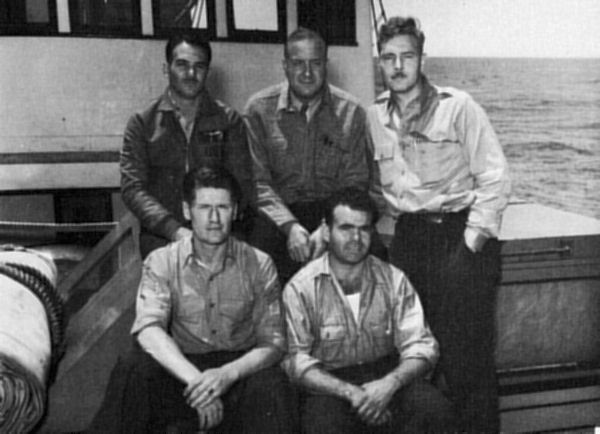
During the sea voyage the Snow Cruiser team (Figure 3) made necessary repairs, revising the hydraulic systems and preparing the vehicle for Antarctic travel. They installed gyrocompasses, small generators, equipment for the galley, machine shop and living quarters and additional electric wiring, and made mountings that would allow them to fit dual wheels. As North Star entered Antarctic waters, rough seas and low temperatures made work increasingly difficult. Some of the tasks remained unfinished as the ship approached Bay of Whales in the Ross Ice Shelf, where Byrd's earlier Little America bases had been sited and the new West Base was to he established. Poulter's responsibilities in the US prevented him from overwintering, but he hoped to see his Snow Cruiser safely ashore and put through her paces before North Star had to leave.
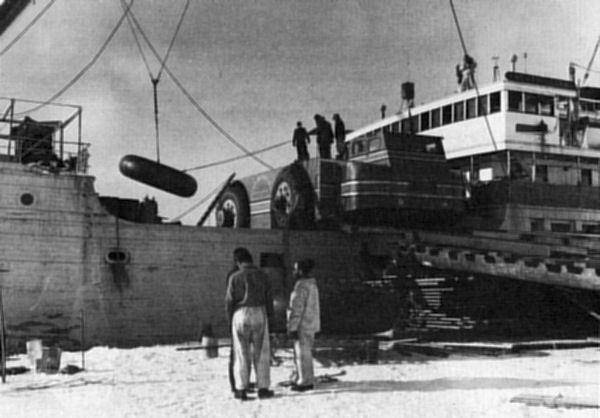
The ship reached Bay of Whales early in January 1940, to find thin sea ice extending up to eight miles [13 km] from the coastal ice cliffs, There was no prospect of stores being unloaded directly onto the ice shelf. Approaching with difficulty to within four miles [6.5 km] of the cliff, Byrd, Siple (the West Base leader) and Poulter decided to offload onto The ice. The Snow Cruiser, which covered a hatch, had to come off first. In an unpublished typescript given to Dibbern in 1977, Poulter described how, because the side of the ship was 14 ft [4.5 m] above the ice surface, the vehicle had to be driven precariously down a makeshift ramp of timber and steel (Figure 4). With Byrd standing on the roof, and guided by radio-operator Ferranto, Poulter felt the ramp break under his left front wheel, but accelerated down to reach the sea ice safely. He describes that first over-snow run of the Snow Cruiser thus:
| It felt as though something must be dragging as a result of the mishap on the gangway as the Cruiser would travel only about three miles an hour [5 km per hour] Under full throttle, but we did not stop until it was about one half mile [0.8 km] from the edge of the ice. At this point we stopped and made a very thorough inspection and found everything to be perfectly free so far as the whees and driving mechanism were concerned. The tires were sinking into the snow approximately 8 or 10 inches [20-25cm] and much to our surprise the snow on the bottom of the track was not packed but was very loose for a depth of 10 to 12 inches [25-30 cm]. |
This underlines, the paradox in Poulter's snow analysis. None of his actual data on snow properties are known and we can only infer that his understanding was based largely on his comparison of cold dry snow and sand. Here for the first time he was faced with the quite different properties and packing behaviour of wet snow close to freezing point.
|
Poulter drove a further three miles [5 km] in one and a quarter hours. Finding the wheel motors hot, and having spent 48 hours without sleep, the crew rested for a few hours. Then they tried to climb a snow slope that would get them onto the safety of the ice shelf:
| After travelling some distance, the snow became soft and the wheels sunk in approximately 2 feet [0.6 m] and the Cruiser stalled. We backed up and tried in two other places with no better luck. The snow was abnormally soft at this point so we got a large number of short pieces of heavy plank and laid them crosswise under the wheels. After travelling approximately 100 feet [30 m] in this manner, we were able to proceed very slowly without the planks with the tires sinking 8 to 12 inches [20-25 cm]. Occasionally, it would stall and it would be necessary to back up a few feet and then pull forward again. Since we were on comparatively safe ice now we decided to stop and take stock of the situation. |
The crew installed chains on the rear wheels and fitted the two spares outside the front wheels, increasing the surface area of tyre by 50% (Figure 4). Poulter calculated that loading would be below 70 kPa, yet with almost no payload the vehicle was still barely able to move. They tried lowering tyre pressures until the side walls wrinkled (when they were probably less than 70 kPa, though Wade said later that they never really knew what the tyre pressures were), and different combinations of gears and electrical settings to generate more wheel thrust. The pace remained painfully slow, stopping, reversing, and advancing again until the motors overheated. In one of the last efforts of the Snow Cruiser that summer, it took 15 hours to move 1.5 km. When Poulter measured the load-supporting ability of the snow in tracks behind the vehicle, he found that only 15 or or 20 kPa could be applied without great sinkage.
|
On 24 January North Star was ready to depart, and Poulter reluctantly left his vehicle helpless in the snow. Concluding that the Snow Cruiser would not operate satisfactorily without major modifications that could not be done in the field, he left his crew with instructions to try again when the snow became colder. The crew in fact made several efforts to get the Snow Cruiser going. At one point, when days of preparation and much labour had resulted in a net advance of 3 miles, Wade (1940) recorded in the daily log his belief that the Snow Cruiser had moved as far as it would ever go.
They tried once more in the intense cold of early spring, carefully cleaning and repairing hydraulic lines, replacing fuses, running the engines, and digging a long ramp of snow to get the vehicle out of the drifts in which winter storms had buried it. The huge vehicle pulled itself up the ramp and onto the level snow, rolling nicely along the surface without sinking so deeply as before. The crew celebrated with a carefully hoarded bottle of brandy and looked forward to an exploring trip. The celebration was premature, however; when next they tried to operate the Cruiser, the hydraulic lines were clogged. They were cleared and the crew again tried to move the vehicle, but this time it sank deeply into the snow and became virtually immovable. Wade complained that although the temperatures dropped to -54°C the snow was different, with the top 75 mm capping unconsolidated, powdery snow beneath. There followed more mechanical problems; fuel pumps gave out, valves stuck and fuses blew. Finally, it became obvious that the Snow Cruiser had indeed moved as far as it ever would. The good spring weather had to be used more productively and the Snow Cruiser returned to the role it served best - snug living quarters for its frustrated crew. There it remained and was abandoned when the expedition returned to the United States.
|
The Snow Cruiser was rediscovered during International Geophysical Year (1958-59) operations by the United States at the Bay of Whales, and records then recovered were sent to the US National Archives. It narrowly escaped when a portion of the ice shelf carrying IGY camps Little America IV and V broke off and drifted away shortly afterwards. Its departure occurred sometime in the 1960s, when another large portion broke away and drifted out to sea. Undoubtedly Dr Poulter's Snow Cruiser is now at the bottom of the Southern Ocean.
Retrospect
What was wrong with the Snow Cruiser? In designing so ambitious a vehicle for use in snow, Poulter was quite simply far ahead of his technology. Few had previously tried to run vehicles of any size on snow. Shackleton in 1908 had found little success with a stripped-down motor car. Wheeled vehicles worked on ice but not on snow, but there were no measurements or systematic observations to say why. Poulter had seen tracked vehicles running successfully on deep snow, and could not see why suitably clad wheels, large enough to distribute weight and minimize pressure over the surface, should not work just as well.
During the 1920s and 1930s significant advances were made in designing wheeled vehicles for use in loose desert sand. Empirical rules guided vehicle designers and users, including the points that large tyres were more efficient than small ones, and pneumatic tyres performed better at lower inflation pressures. Poulter may not have been aware of this research. In his early data-collecting and calculations he had been impressed by similarities in the properties of sand and of cold hard snow. Was he drawing optimistic conclusions about wheeled vehicles on snow from the reports of wheeled vehicles on sand? If so he would have needed far more sophisticated extrapolations, for the two materials behave differently in many ways, even at very low temperatures, and his projected vehicle was in any case much larger than any that had hitherto been tried, on sand or snow. Relating inflation pressures directly to the bearing strength of the snow was a further over-simplification. The results of his test runs in the Indiana sand dunes may have lured Poulter into a false sense of security; he would have seen no reason to examine more closely the real consequences of the differences between sand and snow.
Siple (1959) may have come close to the solution of the problem when, in retrospect, he expressed surprise that although the Snow Cruiser could ascend hills, '...on the level. by some oddity, it sank into the snow 15 cm deep and then could not climb over the curb of the higher snow in front of its wheels'. Faced by the final immobility of his vehicle in 1941, Poulter had wondered if the snow was weaker than it had been when he had measured it almost 10 years before. Testing revealed that in its natural state it could indeed support 200 kPa; however, he noted now that with more pressure added, the snow grains broke apart and collapsed to a loose granular mass. The coefficient of friction between rubber tyres and snow remained high enough to ensure that the wheels would not slip on undisturbed snow. However, the great weight of the vehicle was causing the wheels to sink deeply, so that the climb-out was equivalent to ascending a 20-30% slope. Power had to be expended to break the snow structure and climb this 'slope'; applied to the tyres this overcame friction and caused wheel slip (confirmed in film footage of the vehicle in Antarctica), which served only to deepen the wheel ruts.
Simple calculations, based crudely on the differing properties of snow and sand, suggest that for the tyres available the Snow Cruiser was too heavy by a factor of three to five. Even with dual wheels the load per tyre for the vehicle itself would have been too great. A cruiser built to aircraft rather than railcar designs might have travelled farther. In later writings Poulter expressed his belief that, had he been able to change the gear ratios in the hub motors, the vehicle might have worked better; in the light of what is known today of vehicle-surface interaction, this would merely have increased the torque and caused more wheel slip but no more traction. Even today untracked wheeled vehicles are used only sparingly in Antarctica, and never on long-distance journeys across the continent.
Poulter's personal disappointment was keen. His widow remarked soon after his death that the six months spent in building and delivering 'the monster' and its subsequent failure were a traumatic experience for him. However, his principles included never looking back or regretting his mistakes, not letting his visions be bounded by limitations of present knowledge, and letting his enthusiasms flow out to engulf and inspire others. The qualities these principles inspired in Poulter would not allow him for long to mourn the Snow Cruiser, which despite its failure remains a monument to pioneering ingenuity and enterprise.
Acknowledgements
This account could not have been completed without the kind assistance of Alison Wilson, Dr Franklin Burch and the late Gerald Pagano of the Polar Archives of the National Archives in Washington, DC. We thank also the late E. J. 'Pete' Demas and the late Dr D. F. Alton Wade for answering many questions during the initial stages of research. Finally, the most invaluable assistance, advice and information were rendered by the late Dr Thomas C. Poulter, and after his death by his wife, Helen G. Poulter, to whom the authors owe much.
References
BYRD, R. E. 1935. Discovery, New York. G. P. Putnam.
DAVIS, A. F. 1939. Construction of the Antarctic Snow Cruiser. Automotive Industries, 15 (September).
DEMAS, E. J. 1936. Tractor operations on the Second Byrd Antarctic Expedition. Polar Record, 12 (July): 175-84.
FITZPATRICK, P. J. 1940. The Antarctic Snow Cruiser. Western Society of Engineers, 45 (June).
MECHANICAL ENGINEER. 1939. Snow Cruiser. Mechanical Engineer, September 1939.
POULTER, T. C. 1977. Over the years. Menlo Park, Stanford Research Institute.
SIPLE, P. 1959. 90° South. New York, G. Putnam.
WADE, F. A. 1940. Daily log of the Snow Cruiser 15 Mar 40. Record Group 126, Polar Archives of the National Archives.

| 
|